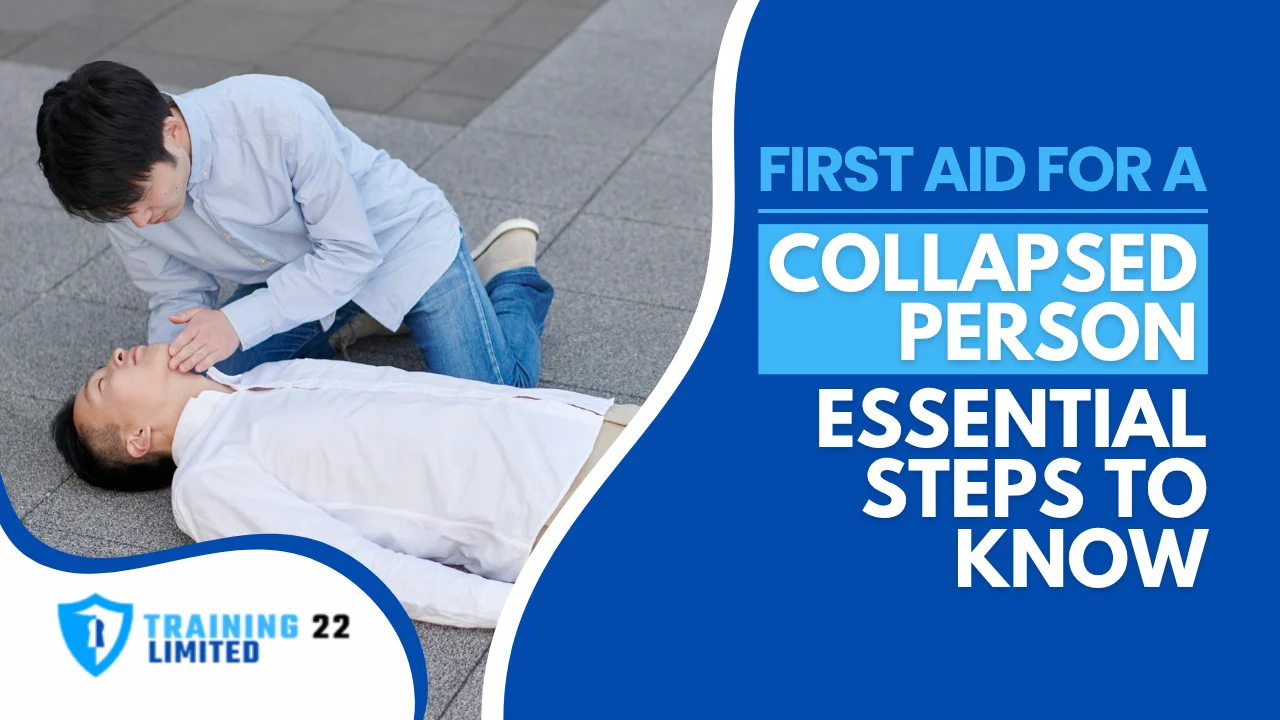
Seeing someone suddenly fall can be shocking. One moment they are talking or walking, and the next they are on the ground and may not answer you. In that scary moment, knowing a few simple steps can help you protect them, call for help, and even save their life.
You don’t have to be a doctor or paramedic to help someone who has collapsed. Anyone can check for danger, see if the person is responsive, call 999, check their breathing, start CPR, and use an automated external defibrillator (AED). The ambulance call handler can also guide you step by step.
Acting quickly when someone collapses can really help. This section covers the key steps for responding to a collapsed person in the UK. It includes checking if they are responsive, recognising abnormal breathing, doing CPR, using an AED, placing someone in the recovery position, and handling the situation safely in public or work areas.
Emergency warning: Call 999 right away if a person is unresponsive, not breathing normally, having severe trouble breathing, has a serious injury, or looks very unwell. This article is meant to educate but does not replace proper first-aid training or emergency-service advice.
When Seconds Feel Like Hours: Understanding Sudden Collapse
People can collapse for many reasons, such as heart problems, fainting, seizures, strokes, low blood sugar, severe bleeding, poisoning, breathing issues, allergic reactions, head injuries, or other serious health issues. As a bystander, you don’t need to know the exact cause to help.
Focus on immediate life threats. First, check if the area is safe, if the person responds, and if they are breathing normally. These steps help you identify when urgent action is needed.
A collapse doesn’t always mean a heart problem. Some people who faint may wake up quickly, while others might stay unconscious but still breathe. Since it’s hard for someone without training to know the cause right away, every unexplained collapse should be treated seriously.
The important thing is to take action instead of waiting for someone else to help. In busy public places, others might think someone else has called for help. Taking charge, assigning tasks, and starting your assessment can save valuable time.
Common warning signs before a collapse
Sometimes a person collapses without warning. In other situations, they may first experience:
- Sudden dizziness or weakness
- Chest pain or pressure
- Severe shortness of breath
- Confusion or unusual behaviour
- Loss of balance
- Pale, sweaty or clammy skin
- Blurred vision
- A severe headache
- Shaking or seizure activity
- Difficulty speaking
- Nausea
- A rapid or irregular heartbeat
Even if the person wakes up, serious symptoms like chest pain, trouble breathing, weakness on one side, or ongoing confusion still need immediate medical attention.
Make Safety Your First Move
Before helping a collapsed person, take a moment to look for danger. You don’t want to become a second victim. Check for risks like traffic, electricity, fire, smoke, broken glass, falling objects, aggressive people, chemicals, or machines.
For instance, if someone falls on the road, don’t rush into traffic. Ask someone else to stop the cars if it’s safe. If the person is near live wires, don’t touch them until someone qualified turns off the power.
This first step is often called “danger” in the DR ABC primary survey:
- D – Danger
- R – Response
- A – Airway
- B – Breathing
- C – Circulation or CPR
The Resuscitation Council UK advises calling 999 immediately if someone is unresponsive. The ambulance operator can help you check breathing and guide your next steps.
Should you move a collapsed person?
Do not move someone unless necessary, especially if they might have injured their head, neck, or spine from a fall, crash, or serious injury. You may need to move them if they are in immediate danger or if you need to place them flat for CPR or to keep their airway clear.
Saving a life is the most important thing. Don’t let worries about spinal injuries stop you from opening the airway or starting CPR if someone isn’t breathing normally. St John Ambulance recommends calling 999 or 112 and starting CPR for anyone who is unresponsive and not breathing properly.
Checking Responsiveness: Is the Person Awake?
Once it’s safe, kneel next to the person and see if they respond. Speak loudly and clearly. You can say:
“Hello, can you hear me? Are you all right?”
Gently shake their shoulders while watching for movement, speech, eye opening, or another purposeful response. Do not shake them violently, slap their face, or pour water over them.
This stage of checking responsiveness helps you tell if someone is awake, partly awake, or completely unresponsive. A person might groan, move a bit, or open their eyes but not be fully alert. Take any signs of reduced consciousness seriously.
If the person responds, keep them in a safe position and ask what happened. Check for any obvious injuries or urgent symptoms. Reassure them, keep them warm, and call for medical help if needed. Don’t try to help them stand right away, as they may fall again.
If the person doesn’t respond, shout for help. In the UK, call 999 for someone who is unresponsive before checking their breathing. Put your phone on speaker so the call handler can guide you while you stay with the person.
How to organise other bystanders
Use direct instructions rather than shouting general requests. For example:
- “You in the blue coat, call 999.”
- “Please bring the nearest defibrillator.”
- “Ask reception for a trained first aider.”
- “Keep the entrance clear for the ambulance.”
- “Move these chairs so we have space.”
- “Come back and tell me when the call has been made.”
Clear directions are very helpful during a medical emergency in public places. Noise, crowds, and confusion can make it harder to get help.
If you’re alone, call 999 and use the speaker function. Tell the operator where you are, what happened, if the person is awake, and what you see. Don’t hang up unless the operator tells you to.
Open the Airway and Check for Normal Breathing
When a person is unresponsive, their muscles relax, which can cause the tongue to block the airway. To check if they are breathing, you need to open the airway.
Put one hand on their forehead and gently tilt their head back. Use your other hand to lift their chin. This is called the head-tilt, chin-lift technique.
Be careful not to press too hard under the chin, as it may worsen the blockage. Avoid putting your fingers inside the mouth unless you can see an object clearly and can reach it safely.
Next, check for normal breathing. Look for the chest moving, listen for sounds near the mouth and nose, and feel for breath on your cheek. Do this for no more than ten seconds. According to NHS guidelines, you should check for chest movement, breathing sounds, and breath for up to ten seconds.
What counts as normal breathing?
Normal breathing looks steady and effective. A person in cardiac arrest may make occasional gasps, snorts, or irregular breaths. These are known as agonal gasps and should not be confused with normal breathing.
The NHS says that gasping or irregular breathing is not normal. So, if an unresponsive person only gasps or breathes abnormally, get ready to start CPR and follow the 999 operator’s instructions.
Recognising this difference is a key first aid skill. Sometimes people hesitate to start CPR because they see the person taking an occasional breath. However, these ineffective gasps do not count as normal breathing.
Your decision after checking breathing
You will usually reach one of two conclusions:
- The person is unresponsive but breathing normally.
- Call 999, protect the airway, consider the recovery position and monitor them continuously.
- The person is unresponsive and not breathing normally.
- Call 999, begin CPR and use an AED as soon as one becomes available.
Not Breathing Normally? Start CPR Immediately
If an adult is unresponsive and not breathing normally, treat it like a cardiac arrest. Start CPR right away. CPR helps send oxygen-rich blood to the brain and vital organs until professional help arrives.
Don’t waste time looking for a pulse unless you are trained as a healthcare professional. For everyone else, unresponsiveness and abnormal breathing are enough reasons to begin CPR.
CPR basics can seem overwhelming, but the key is to start right away. The ambulance caller will guide you through the steps and help you keep going until emergency responders arrive.
How to perform adult chest compressions
Follow these steps:
- Place the person flat on their back on a firm surface.
- Kneel beside their chest.
- Put the heel of one hand in the centre of the chest on the breastbone.
- Place your other hand on top.
- Interlock your fingers and lift them away from the ribs.
- Position your shoulders directly over your hands.
- Keep your arms straight.
- Press the chest down firmly.
- Release the pressure fully after each compression.
- Continue at a fast, regular rhythm.
For adults, UK guidance suggests pushing down on the chest about five to six centimetres at a rate of 100 to 120 compressions per minute. Keep breaks short.
Let the chest rise completely after each compression. Don’t lean on the chest all the time, as full recoil helps the heart refill between compressions.
CPR with rescue breaths
If you are trained and willing to give rescue breaths, use a cycle of:
- 30 chest compressions
- 2 rescue breaths
After 30 chest compressions, open the airway by tilting the head back and lifting the chin. Pinch the person’s nose shut, cover their mouth with yours, and blow steadily until the chest rises. Give a second breath, then go back to compressions right away.
Make sure each breath is strong enough to raise the chest. Don’t blow too hard or too long.
Hands-only CPR
If you’re not trained or can’t give breaths, just do continuous chest compressions. Hands-only CPR is much better than doing nothing.
According to Resuscitation Council UK, compression-only CPR can be helpful in the first few minutes of adult cardiac arrests, especially while waiting for emergency help or an AED.
Keep doing CPR until:
- The person shows clear signs of life and breathes normally.
- An AED tells you to stop.
- A trained professional takes over.
- The scene becomes unsafe.
- You can’t continue.
Suppose someone else is nearby and can help; switch off every two minutes or sooner if you’re tyred. Keep interruptions brief.
The AED Advantage: Let the Defibrillator Guide You
An automated external defibrillator, or AED, checks the heart’s rhythm and can give a shock if needed. You don’t need medical training to use one.
You can often find AEDs in busy places like shopping centres, airports, schools, and workplaces. Look for signs with a heart and a lightning bolt.
If someone is nearby, ask them to get the nearest AED. Don’t leave the person alone to search for one unless the 999 operator tells you to.
How to use an AED
When the device arrives:
- Switch it on or open its lid.
- Listen carefully to the voice prompts.
- Expose the casualty’s chest.
- Remove or cut through clothing when necessary.
- Take the electrode pads out of their packaging.
- Attach them to the bare chest as shown on the pad diagrams.
- Make sure nobody touches the person while the AED analyses the rhythm.
- If a shock is advised, clearly shout, “Stand clear.”
- Deliver the shock when instructed.
- Resume CPR immediately when prompted.
The Resuscitation Council UK advises using an AED right away when you have one. Place the pads on the bare chest following the instructions, and listen to the device’s prompts.
The AED only shocks if it finds a heart rhythm that needs it. You can’t accidentally shock someone just by pressing the button.
Practical AED considerations
If the chest is wet, quickly wipe it so the pads stick. Take off any medication patches that might block the pad placement, using protection if you have it, and clean the area. Do not place a pad directly over an implanted device; position it slightly away as the AED’s diagrams show.
Don’t hesitate to use the defibrillator because you feel nervous. Turn on the machine, follow its instructions, and let it guide you.
Learning to use an AED in basic life support training helps you feel more comfortable in an emergency. Hands-on training allows you to practise safe pad placement, coordinate CPR, and communicate clearly with other rescuers.
Breathing Normally but Unresponsive: Protect the Airway
If a person is unresponsive but breathing normally, they don’t need CPR at that moment. However, their airway can still be blocked by their tongue, vomit, or other fluids.
Call 999 and keep a close watch on them. Often, placing them in the recovery position helps keep their airway clear and allows fluids to drain from their mouth.
Current first-aid guidelines recommend using the side-lying recovery position for adults and children who are less responsive but don’t need CPR. Avoid using this position if the person is gasping for breath or if moving them could cause harm.
Recovery position guide
For a non-traumatic collapse where the person is breathing normally:
- Kneel beside the person.
- Remove their glasses if they are wearing them.
- Straighten both legs.
- Place the arm nearest you at a right angle to the body, with the palm facing upwards.
- Bring the far arm across the chest.
- Hold the back of that hand against the cheek nearest you.
- Bend the far knee so the foot rests flat on the ground.
- Keeping the person’s hand against their cheek, pull the bent knee towards you.
- Roll the person carefully onto their side.
- Adjust the upper leg so the hip and knee form roughly right angles.
- Tilt the head backwards to keep the airway open.
- Position the mouth so fluids can drain.
- Recheck breathing continuously.
This method follows the general sequence described in NHS recovery-position guidance.
Continue monitoring
Putting someone in the recovery position isn’t enough. Stay with them, watch their chest, and check their breathing.
If their breathing becomes irregular, gasping, or stops, roll them onto their back and start CPR. Call the ambulance right away if their condition changes.
Keep them warm with a coat or blanket, but don’t let them get too hot. Don’t give them food, drink, or medication if they are less alert.
What If the Collapse Was Only a Faint?
A faint is a quick loss of consciousness due to reduced blood flow to the brain. People can faint due to heat, pain, emotions, standing too long, dehydration, or other reasons. It’s important not to assume someone is “just fainting” until they recover and warning signs are considered.
If someone feels faint but is still conscious, help them lie down and raise their legs slightly if possible. Loosen any tight clothing around their neck, and encourage fresh air while asking crowds to step back.
St John Ambulance recommends helping someone who feels faint by having them lie down, raising their legs, and providing fresh air. Once they feel better, help them sit up slowly. If they don’t respond, open their airway, check their breathing, and treat them as an unresponsive person.
After the person regains consciousness
Reassure them and encourage them to stay lying down for a few minutes. Don’t rush them to sit or stand. Help them sit up slowly when they feel ready.
Call 999 when:
- They do not regain consciousness promptly
- Their breathing is abnormal
- They have chest pain
- They have severe difficulty breathing
- They appear to have had a seizure
- They have suffered a significant injury
- They show signs of a stroke
- They fainted during exercise
- They have repeated episodes
- They are pregnant and remain unwell
- You are concerned about their condition
If someone seems better, remind them to see a doctor if the cause is unclear or if the situation is unusual.
Special Situations That Can Cause Collapse
The same first aid steps apply to most collapses: check for danger, see if the person is responsive, call 999 if needed, open the airway, and check if they are breathing. However, some situations need extra attention.
A seizure
During a seizure, keep the person safe by moving away from hard or sharp objects. Cushion their head and note the time. Don’t restrain them or put anything in their mouth.
After the shaking stops, check their airway and breathing. If they are unresponsive but breathing normally, and it’s safe to move them, place them in the recovery position. Call 999 if the seizure lasts too long, happens again without recovery, causes injury, occurs in water, involves a pregnant person, is their first seizure, or raises concerns about their breathing.
Suspected stroke
Use the FAST check:
- Face: Has one side of the face dropped?
- Arms: Can they raise both arms?
- Speech: Is their speech slurred or confused?
- Time: Call 999 immediately.
A stroke can cause sudden weakness, confusion, vision issues, or loss of balance. Do not give food, drinks, or medicine. Keep the person safe and watch their breathing.
Low blood sugar
A person with diabetes might feel shaky, sweaty, confused, weak, or unresponsive. If they are awake and can swallow safely, they should have a quick source of sugar as their management plan suggests.
Do not give food or drink to someone who is unconscious or not responding well. Instead, call 999, check their breathing, and position them in the recovery position if it’s safe to do so.
Severe bleeding
Check for serious bleeding right away. Use a dressing, a clean cloth, or your hands with gloves to apply firm pressure. Ask someone else to call 999 and get a first-aid kit.
Don’t focus on a small injury and ignore the person’s airway or breathing. Deal with life-threatening issues based on how urgent they are.
Choking
A choking person may stay awake at first, but they could fall if the blockage isn’t removed. If an adult choking victim becomes unresponsive, gently lower them to the ground, call 999, and start CPR. Check their mouth before giving breaths and only remove an object if you can see it clearly and easily reach it.
Suspected poisoning or overdose
Look for medicine packets, containers, fumes, or other signs, but avoid dangerous substances. Call 999 and follow their instructions. Don’t make the person vomit or give them food and drink unless a healthcare professional tells you to.
Managing a Public Place Medical Emergency
A collapse in a restaurant, office, shop, train station, or community space creates extra problems. Crowds may gather, people might film, and staff may be unsure who is in charge.
Start by clearing space around the injured person. Ask onlookers to step back but keep one or two helpers close. Protect the injured person’s dignity, but don’t delay lifesaving care for privacy.
Assign roles:
- One person calls 999.
- One person finds an AED.
- One person alerts a trained first aider.
- One person directs ambulance crews from the entrance.
- One person manages the crowd.
- One person notes important times if possible.
Give the 999 operator the exact location. In a large building, include the floor, room number, entrance, and nearest landmark. Have someone meet the ambulance crew to save time.
Information to give emergency services
Be ready to explain:
- What happened
- Whether the person responds
- Whether they are breathing normally
- Whether CPR has started
- Whether an AED has been used
- The person’s approximate age
- Any known medical condition
- Any visible injury or bleeding
- The exact location
- Hazards at the scene
- Changes in the person’s condition
Do not stop first aid to collect a detailed medical history. Lifesaving actions come first.
Mistakes Beginners Should Avoid
Many people hesitate because they worry about making a mistake. However, not asking for help or starting CPR can be more dangerous than trying and failing.
Knowing common mistakes can improve your first aid skills and boost your confidence to act.
Mistake 1: Assuming Someone Else Will Call 999
Don’t assume others will act. Point to a specific person and ask them to call 999. Make sure they confirm the call.
Mistake 2: Ignoring Gasping
Gasping or irregular breaths can happen during cardiac arrest. If a person isn’t responding and isn’t breathing normally, start CPR.
Mistake 3: Taking Too Long to Check Breathing
Check for normal breathing for no more than ten seconds. If unsure, tell the 999 operator what you see and follow their guidance.
Mistake 4: Looking for a Pulse
It’s easy to misunderstand a pulse check. Focus on whether the person is responsive and breathing normally.
Mistake 5: Giving Drinks to an Unconscious Person
An unconscious person might inhale liquid. Don’t give anything by mouth.
Mistake 6: Stopping CPR Too Often
Keep breaks short. Continue compressions while preparing the AED, only stopping when the device tells you to.
Mistake 7: Not Using an AED
AEDs are made for public use. Turn it on and follow the instructions.
Mistake 8: Leaving an Unconscious Breathing Person Alone
Their condition can worsen quickly. Keep watching their breathing until help arrives.
Mistake 9: Trying to Diagnose the Cause
Don’t waste time figuring out what caused the collapse. Start the primary assessment right away.
Mistake 10: Delaying Due to Embarrassment
You may need to uncover the chest for CPR or AED pads. Respect dignity as much as possible, but don’t delay lifesaving treatment.
A Simple Collapsed Person Emergency Response Checklist
In a stressful situation, it’s often easier to remember a short list than a long explanation. Here’s a checklist for helping an adult who has suddenly collapsed:
Step 1: Check for danger
Make sure it is reasonably safe to approach.
Step 2: Check responsiveness
Speak loudly and gently shake the shoulders.
Step 3: Call 999
Call immediately for an unresponsive person and use speaker mode. Ask for an AED.
Step 4: Open the airway
Use a gentle head tilt and chin lift.
Step 5: Check breathing
Look, listen, and feel for normal breathing for no more than ten seconds.
Step 6A: If breathing normally
- Keep the airway open
- Use the recovery position when appropriate
- Monitor breathing
- Keep the person warm
- Wait for emergency help
Step 6B: If not breathing normally
- Start chest compressions
- Give rescue breaths if trained and willing
- Use an AED as soon as possible
- Follow the 999 operator’s instructions
- Continue until help takes over
These emergency assessment steps are easy, but you need to stay calm and practise them often to do them well.
Why Practical First-Aid Training Matters
Reading about emergency care raises awareness, but hands-on training builds confidence. Stress during an emergency can affect how we think and communicate. Practising with manikins and AED simulators turns information into real skills.
A basic life support course helps learners practise checking responsiveness, opening airways, recognising abnormal breathing, performing chest compressions, and using an AED. Instructors can correct hand position, compression depth, and body posture before an emergency happens.
Training also promotes teamwork. Learners practise giving clear instructions, switching CPR performers, communicating with ambulance services, and managing the scene.
In the capital, basic life support training can create safer workplaces and more confident teams. This training is especially important for office staff, hospitality workers, teachers, security personnel, caregivers, fitness professionals, volunteers, and anyone working with the public.
Training 22 offers health and safety education to help learners respond better in emergencies. Their basic life support training provides practical instruction on CPR, AED use, and emergency assessment.
Employers should evaluate their first-aid plans. The Health and Safety Executive requires employers to provide immediate help if workers become ill or injured at work.
Based on workplace risks, Training 22’s First Aid at Work or Emergency First Aid at Work courses can help organisations improve their emergency response.
Supporting Someone After They Recover
When someone wakes up, they might feel scared, confused, embarrassed, or determined to get up. Encourage them to stay still while you check on how they feel.
Ask simple questions like:
- “Do you know where you are?”
- “Do you know what happened?”
- “Do you have any pain?”
- “Are you having trouble breathing?”
- “Do you have a medical condition?”
- “Are you taking any medication?”
- “Has this happened before?”
Don’t ask too many questions at once. Speak softly and explain what you’re doing. Keep them warm and respect their privacy.
Even if they seem fine, don’t cancel emergency help without talking to the call handler first. A short improvement doesn’t always mean the problem is gone.
If they become drowsy, confused, or unresponsive again, check their airway and breathing right away.
Frequently Asked Questions About First Aid for a Collapsed Person
Should I call 999 if someone collapses?
Call 999 if the person is unresponsive, not breathing normally, has serious symptoms, is seriously injured, or does not recover quickly. If you’re unsure, call and explain the situation. The operator will help decide if it’s urgent.
What should I do first if someone is unconscious?
Check for dangers in the area, see if the person is responsive, and call 999. Then open the airway and check if they are breathing normally.
Should I put every unconscious person in the recovery position?
No. Use the recovery position only if the person is unresponsive but breathing normally. Don’t use it for someone who needs CPR. Current guidelines say not to use it for cases of gasping or trauma.
What if I can’t tell if they are breathing?
Call 999, put the phone on speaker, and explain what you see. The call handler can help you. If the person is unresponsive and not breathing, start CPR.
Can performing CPR hurt someone?
Chest compressions are strong and might cause injury, but an unresponsive person not breathing is in danger. Doing CPR gives them a chance to survive. Waiting out of fear can decrease their chance of survival.
How fast should chest compressions be?
For adults, aim for 100 to 120 compressions per minute. Push the chest down about five to six centimetres and let it rise fully after each push.
Do I have to give mouth-to-mouth breaths?
If you are trained and willing, give 30 compressions followed by two breaths. If not, continue with chest compressions only and follow the ambulance operator’s instructions.
Can someone untrained use an AED?
Yes. Public-access AEDs give spoken or visual instructions. Attach the pads as shown and follow the prompts. The machine will check the heart rhythm and advise a shock only if necessary.
What if the person starts breathing during CPR?
Stop briefly to check if they are breathing normally and showing signs of life. If they breathe normally, protect their airway and place them in the recovery position if necessary. Monitor them closely. If you’re unsure, follow the operator’s instructions.
What if the person collapses after falling?
If someone has fallen and may have a head, neck, or spinal injury, avoid moving them. Open their airway and start CPR if they aren’t breathing normally, because keeping them alive is the most important priority.
Can I give medicine to an unconscious person?
No, do not give food, drink, or medicine to someone who is unconscious or not responding well. Only give medicine when the person is awake, can swallow, and if a professional or emergency service advises it.
How can I remember all the steps?
Remember this: Safe – Respond – Call – Airway – Breathe – CPR or Recovery Position – AED – Monitor.
Taking a basic life support course can make it easier to remember these steps when you need to act quickly.
From Bystander to Lifesaver: Confidence Comes From Preparation
A sudden collapse is a serious emergency. You don’t need to know what caused it. Focus on immediate dangers, check if the person is responsive, call 999, assess their breathing, and act based on your findings.
If the person isn’t breathing normally, start CPR and use an AED. If they are breathing normally but unconscious, keep their airway clear, place them in the recovery position, and keep monitoring them.
These steps are essential first aid for someone who has collapsed. They are practical skills anyone can learn and use at home, work, or during emergencies in public.
Don’t hesitate to help. Call 999, put your phone on speaker, and follow the operator’s instructions. Quick action by a bystander can be more effective than waiting for professionals.
If you want to feel more confident, Training 22 offers basic life support courses that include supervised practise in CPR, AED use, and care for unconscious people. Being prepared can help you respond calmly and effectively in critical situations.